Stop blaming WordPress. The problem is usually the infrastructure.
In the modern digital ecosystem, speed is not merely a feature—it is the currency of trust. Studies consistently show that a delay of just 100 milliseconds in page load time can drop conversion rates by 7%. For an e-commerce business, this latency is not just a technical annoyance; it is a direct revenue leak.
While the WordPress ecosystem offers thousands of “speed optimization” plugins promising instant results, true performance cannot be achieved by simply installing software on top of a crumbling foundation. You cannot fix a structural problem with a fresh coat of paint.
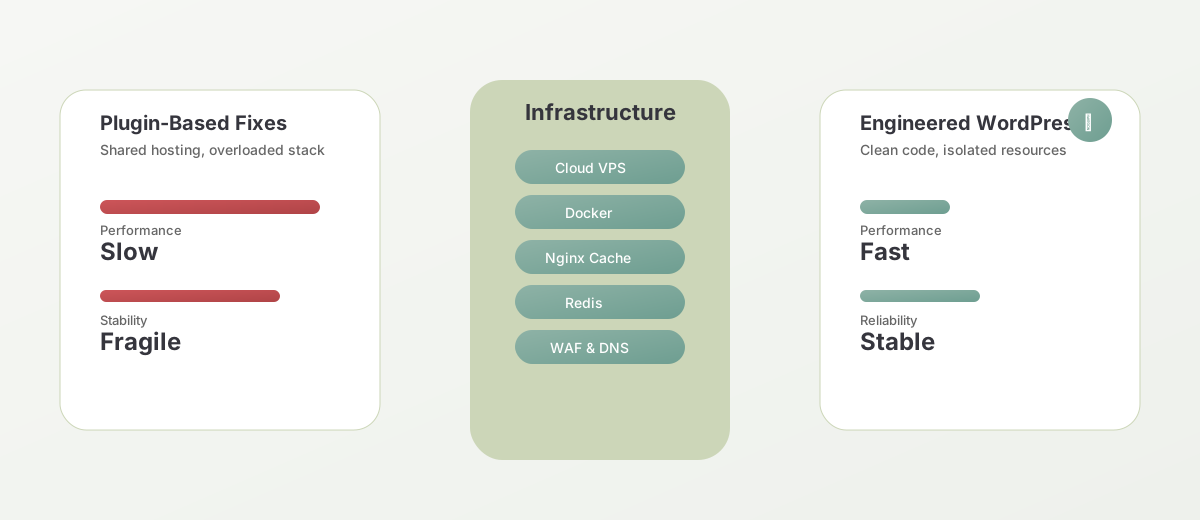
At k-libre, we take a divergent path. We believe that high-performance web architecture starts long before the first line of PHP is executed. It starts with the metal. Here is how we engineer speed, stability, and security into the core of your digital presence.
The “Shared Hosting” Trap vs. Dedicated Cloud Compute
Most digital agencies deploy client sites on “Shared Hosting” environments. In this model, your website lives on a single server alongside hundreds, sometimes thousands, of other websites.
The Problem (Noisy Neighbors): If another site on the same server experiences a traffic spike or gets hacked, your site slows down. You are fighting for the same CPU cycles and RAM.
The k-libre Solution: We utilize High-Frequency Cloud VPS infrastructure powered by Oracle Cloud.
- Dedicated Resources: We provision isolated computational power. Your CPU and RAM are yours alone.
- NVMe Storage: We use enterprise-grade storage that reads and writes data exponentially faster than traditional SSDs used by budget hosts.
“You cannot scale a poorly engineered foundation. No amount of caching plugins will save you from infrastructure debt.”
Containerization: Why We Use Docker
Traditional hosting relies on archaic control panels like cPanel that manage files in a messy, intertwined system. We treat your website as a software application, not just a folder of files. We use Docker to “containerize” your WordPress environment.
- Isolation: Your database, your web server (Nginx), and your PHP processes run in their own isolated containers.
- Security: Even if a vulnerability is exploited in one layer, the isolation prevents it from spreading to the host system.
- Portability: Our containerized approach means your site is environment-agnostic. We can move, scale, or replicate your site across different cloud regions in minutes, not days.
The Caching Strategy: Server-Side vs. Application-Side
This is where the engineering difference becomes most visible. Most WordPress users rely on caching plugins. While useful, these plugins operate at the Application Layer (PHP). This means a request still has to wake up the PHP engine to serve a “cached” page.
We move caching deeper into the stack:
Nginx FastCGI Caching
We configure the web server (Nginx) to serve static versions of your pages directly. This bypasses the heavy PHP processing entirely for anonymous visitors.
Result: The server can handle thousands of concurrent users with minimal CPU load.
Redis Object Caching (Crucial for WooCommerce)
For dynamic sites like e-commerce stores, you cannot cache everything visually because carts and user sessions change. This is where the database bottlenecks happen.
The Fix: We implement Redis Object Caching.
How it Works: Instead of asking the database “What is the price of Product X?” every single time a user looks at it, we store the answer in the server’s Memory (RAM). Reading from RAM is thousands of times faster than reading from a Hard Disk.
Impact: Instant add-to-cart actions and lightning-fast checkout flows.
Security as a Performance Accelerator
There is a common misconception that adding security layers slows down a website. This is only true for poorly configured, plugin-based security. When engineered correctly at the network level, security actually accelerates delivery.
WAF (Web Application Firewall): We deploy firewall rules at the edge.
Bad Bot Blocking: Roughly 30-40% of web traffic consists of malicious bots scraping content or looking for vulnerabilities. By blocking this traffic before it hits your WordPress installation, we save valuable server resources for your actual human customers.
DNS Optimization: We utilize premium DNS layers to resolve your domain name faster, shaving precious milliseconds off the initial connection time.
The Frontend: Lightweight by Design
Even the fastest server cannot save a poorly coded theme. Many commercial “Premium” themes come bloated with 50+ JavaScript files, drag-and-drop builders, and unnecessary CSS.
At k-libre, our standard is Minimalist Engineering:
- Framework: We strictly use lightweight frameworks like GeneratePress.
- Code Quality: We avoid “page builders” that generate spaghetti code. Instead, we use native blocks and custom CSS.
- Asset Optimization: We automatically generate WebP images and defer non-critical JavaScript execution to ensure the “Largest Contentful Paint” (LCP) happens in under 1.5 seconds.
“Performance is not about adding more tools. It is about engineering discipline from the ground up.”
Engineering Digital Excellence
Your website is the digital headquarters of your brand. It should not be built on a house of cards.
Whether you are running a high-traffic WooCommerce store, a corporate identity platform, or a complex custom application, the principles remain the same: Clean code, isolated resources, and intelligent caching.
Stop relying on plugins to fix infrastructure problems. Let’s build it right from the foundation.
Ready to upgrade your infrastructure? Contact k-libre today and experience WordPress the way it was meant to be engineered.